Karen Clark, 49
Knoxville, Tennessee
Loves: Rowing
Sports were never Karen Clark’s thing as a kid. But when, in her early 40s, she couldn’t budge a large flowerpot, the computer consultant and married mom of two started to long for muscles. Clark hired a personal trainer and enjoyed the workouts, but was looking for more. Then he had her try a rowing machine, and she liked it enough to sign up for a three-day workshop on the Tennessee River. She came home a changed woman.
“You’re working with a team, and everyone’s focused on the same goal. The sun’s coming up over the water. And I’m thinking, ‘I want to do this as often as I can,’” she says.
Clark now rows three times a week, typically in a shell with eight other women. “When a row goes well, you’ve pushed yourself beyond what you thought you could do. That is exhilarating,” she says.
Now, not only is Clark able to move her own flowerpots, but she’s gone from a size 12 to a size 8. The sport has also brought Clark closer to her daughters, Isabel, 20, and Olivia, 17, who delight in cheering her on. “When your children tell you they’re proud of you, that’s great stuff,” she says.
Last Updated: July 23, 2008
Filed Under: Fitness
Showing posts with label motivation. Show all posts
Showing posts with label motivation. Show all posts
2009/03/19


Get the Body of Your Dreams: Pamela Brown
Pamela C. Brown, 30
Indianapolis, Indiana
Loves: Kickboxing
Pamela Brown’s worst high school grade wasn’t in some brainiac subject like trigonometry or physics. It was in PE. The now-30-year-old, single college administrator barely passed the class after refusing to suit up. “I didn’t like to sweat,” she says.
Brown started running during her college years to lose weight (prompted by a remark from a tactless ex-boyfriend), but gave it up when she moved to Indianapolis in 2001 and experienced her first brutally cold winter. It wasn’t until three years ago, when she walked into a kickboxing class on a whim, that she found a workout she actually looks forward to. The class—turbo kickboxing, a tough, dancelike workout to a hip-hop beat—is a physical escape from day-to-day stresses. “You’re completely in the moment,” she says. “You can’t think about your next move. You just do it.”
Now 20 pounds lighter, Brown says her muscles aren’t her only reward. She hasn’t had a cold in years and has loads of energy. “I’m more upbeat and confident,” she says. “I can do a lot more than I ever imagined.”
Last Updated: July 23, 2008
Filed Under: Fitness
How to (Finally) Get the Body of Your Dreams

There are plenty of us who don’t think of ourselves as sporty types. Maybe you don’t like to sweat, or maybe you’ve gotten real cozy with your couch. That was the story for these five women until each stumbled onto an unexpected surprise: a new kind of workout that not only got her body in motion but was actually fun, too. Find out how they discovered their fitness passions—and get inspired to explore your own. You just might be a late bloomer, too.
Last Updated: July 23, 2008
Filed Under: Fitness
Box Your Way to Confidence
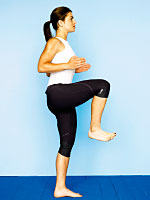
‘Help! I’m feeling wimpy and need a confidence boost.’
We think the perfect person to help this angst-ridden reader is Jillian Michaels. Not only does she regularly whip softies into shape on NBC’s The Biggest Loser, she’s also author of the new book Winning by Losing and a black belt in Akarui-Do (a hybrid of kung fu and Thai boxing). So we asked Jillian—that’s her in the photos—to come up with a confidence-inspiring workout. And she has definitely delivered, with moves that will strengthen your muscles and your self-confidence.
For best results
- Keep your focus and intensity high—and increase your confidence—by picturing a worthy opponent
- To add a cardio element, boost your speed once you’re comfortable
- Do these exercises twice per week
Trainer tip: For an added challenge, hold a 3-pound dumbbell in each hand for moves 1 and 2.
Last Updated: August 6, 2008
Filed Under: Fitness
New Study: Do Exercise Ads Make You Fitter…or Fatter?

By Amanda MacMillan
When I signed up for my first half-marathon back in 2007, I tore a full-page ad for the event out of Runner’s World magazine and hung it on my bedroom wall, so it was the first thing I saw when my alarm went off in the morning. Good thing I didn’t hang it in my kitchen. New research from the University of Illinois suggests that advertisements designed to promote physical fitness may have an unexpected consequence—they actually make people eat more.
The study published this month in Obesity observed 53 college students as they looked at posters from an exercise campaign and later looked at posters that did not mention exercise. The participants were given a handful of raisins after each session. And after looking at the exercise posters they ate one-third more than they did after looking at nonfitness pics—an average of 18 calories, compared with only 12.
Similar results were found with a second test, in which different students played a computer game involving either action words like “active” and “go” or neutral words like “pear” and “moon.” Those who heard the action words ate more peanut M&Ms afterward than the neutral group.
Where and when these ads appear is also an important factor, says Dolores Albarracin, the study’s lead author and a professor of psychology at the University of Illinois. “When the setting of the advertising is more conducive to eating than exercise, people eat,” she told The New York Times last week. “If you just wallpaper everyplace with these kinds of posters, it may not do much good.”
I admit, when I’m really being good about working out every day, I tend to allow myself a few (hundred) extra calories—especially in the form of desserts, drinks, or other “rewards” for making it to the gym. So maybe that’s what subconsciously happened to the people in this study. They thought about exercising and decided to indulge a bit more in return.
But this makes me wonder about the age-old practice of using motivational photos or objects—such as hanging up a bikini, a pair of skinny jeans, or a picture of a celebrity role model—as an inspiration to lose weight or get in shape. I recently replaced that old half-marathon ad with the brand new Team in Training jersey that I’ll wear for my first triathlon in July. Now, whenever I spot it in my bedroom, I’ll try to be aware of any mysterious hunger cravings!
Have you ever used fitness-related props like these as a gentle reminder of your goals? Have they worked? And do you think we need to watch out for absent-minded eating?
Last Updated: March 13, 2009
Filed Under: Get Fit Blog
Get Your Family Involved in Changing Your Eating Behavior

In the spring of 2005, after four pregnancies, Julie Marsh weighed 240 pounds. “I wasn’t happy with myself,” she told Health magazine in April 2007. Inspired by her sister Cathy Andrew, who had resolved to lose weight in 2005, the sisters joined forces in dieting and exercising and had better success.
Research shows that dieters are more likely to change their ways if they feel they have the support of family, a close friend, or a coworker. It worked for this sister team: Along with eating more vegetables and smaller portions, they lifted weights three times a week and went on four to five mile walks at least four days a week. The workout buddies even tried activities they wouldn’t have done alone, like yoga and badminton. A year later, Julie had lost 85 pounds, and her sister had shed 105—a whopping 190 pounds of combined success.
Here are some tips for getting friends and family to support your desire to lose weight:
- Be up-front. Let friends and family know you’re making changes in your eating habits. It may stop loved ones from offering you foods you’re trying to avoid and encourage healthy cooking at group events. Asking them for help also adds accountability.
- Buddy up. The fact is, two-thirds of American adults are overweight and, chances are, you have friends or coworkers who may be interested in changing their eating behavior as well. Research shows that when one person slims down, those around him or her are more likely to lose, according to a 2007 study by researchers at Harvard Medical School and the University of California, San Diego.
- Start small. If you’re worried about food pushers, make small, less noticeable changes instead of obvious ones. It will help you ease into weight loss and avoid unwanted attention. For example, at the next family dinner, use a salad plate when you go through the buffet. Chances are, no one will notice your little switch, and you’ll be consuming less food.
Last Updated: February 27, 2009
Filed Under: Healthier You
Subscribe to:
Posts (Atom)
