Showing posts with label sex. Show all posts

2009/03/19

Yoga for Great Sex


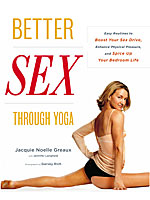
No wonder yoga devotees always seem so blissed-out. According to Jacquie Greaux, author of the new book, Better Sex Through Yoga: Easy Routines to Boost Your Sex Drive, Enhance Physical Pleasure, and Spice Up Your Bedroom Life (Doubleday), “Yoga increases your flexibility and circulation—and therefore your sensation.” Do these moves a few times a week to help prep you for creative maneuvering in the sack. 

Pose: Locust
Position it’s best for: Satisfying Side (facing each other, on your sides)—a way to make love that allows you to relax and enjoy.

Why it helps: Strengthens abs and back; stimulates the pelvis by squeezing glutes and perineum.

How to do it: Lie on your stomach with chin resting on floor, arms at your sides (palms down), and legs together; point toes. Inhale and raise torso, arms, and legs as high as you can. Hold for 3 breaths.

Pose: Killer Hip Opener
Position it’s best for: Splitting Bamboo (him on top, you on bottom with one leg over his shoulder), which allows for deep penetration. Once you start feeling more flexible, try putting both legs over his shoulders for an even more intense experience.

Why it helps: Stretches hips, glutes, and hamstrings; relieves sore or tight pelvis for increased arousal and sensitivity.

How to do it: Sit on floor with your legs together and extended. Bend right knee and place calf on top of left thigh, with right ankle resting just outside left knee. Flex both feet, exhale, and bend forward from waist. Hold for 5 breaths; repeat on opposite side.

Pose: In the Saddle
Position it’s best for: Rock Steady (sitting face-to-face, legs wrapped around each other’s waists), a position that means less work for you so you can concentrate on other things. You’ll love the stimulating entry angle, too.

Why it helps: Opens hips and stretches legs, back, and shoulders; stimulates key acupressure point for sexual energy, located in the middle of your lower back.

How to do it: Sit with outstretched legs opened wide and feet pointed out. Place hands behind butt and push up onto fingers, lengthening and straightening your back while pulling shoulders back and down. Hold for 5 breaths.

Pose: Hello
Position it’s best for: Doggie Style, just the thing when you want deep penetration—and to let your partner control the rhythm.

Why it helps: Stretches backs of legs; increases strength in the pelvis.

How to do it: Stand with legs about 3 feet apart. Bend at waist and touch hands to floor or a block, then move them forward so your back is straight. Place right hand directly under chin and swing left arm up. Hold for 4 breaths; repeat on opposite side.

By Su Reid-St. John

Related Links (Please Search):
3 Lifestyle Habits That Can Boost Your Sex Drive
All About Yoga
Health’s Sexiest Sex Survey EVER!


Last Updated: July 30, 2008
Filed Under: Sex and Relationships

What Is Safer Sex?


By Nick Burns

Safer sex is a general term used to describe methods for reducing the chance that you will spread or catch sexually transmitted diseases (STDs, also known as sexually transmitted infections or STIs). The idea is that with a few simple tools and strategies, you can increase safety without sacrificing your sex life.

Use condoms
The first and best line of defense is to use a latex barrier whenever you have sex (if you have a latex allergy, use polyurethane instead). That means using a condom on the penis or on a sex toy; latex gloves on your hands; and when engaging in oral sex, dental dams or plastic wrap to cover the anus or vagina.

Get tested for HIV and other STDs
Knowing your own status is the only way to approach the next point honestly.

Communicate
Safer sex also involves talking with your partner, discussing activities and risks and making educated choices together. Of course, sex raises a number of other questions. Do you trust your partner? How do you get a guy to use a condom if he refuses to do so? What if you are suspicious that your partner is not being monogamous?

Some people choose to avoid risky activities completely or find ways to reduce the complications associated with them—although this strategy still requires honesty, communication, and STD testing.

Be monogamous or abstinent
Total abstinence is the only 100% effective safe sex method; it’s just not that realistic for most people. Next in line is a long-term monogamous relationship in which both partners know their status to be negative for STDs (itself requiring testing and honest communication), and both stay true to the monogamous ideal.

Last Updated: February 19, 2009
Filed Under: Mother and Daughter

Safest Lubricants and How Meds Affect Your Libido


From Health magazine

Q: I’ve heard that vaginal lubricants carry health risks. Should I worry if I use them?
A:
Vaginal lubricants have been linked to fertility problems and vaginal infections, but this doesn’t necessarily mean that you’re at risk. If you’re trying to get pregnant, definitely steer clear because these products can render sperm immotile, which can decrease your chances of conception.

Not trying to get knocked up? Then it’s fine to use a water-based lubricant, but avoid the oil-based ones because they don’t wash away easily and can create a breeding ground for bacteria.

If you’re prone to yeast infections, don’t use any vaginal lubricant that contains glycerin (a sugar-based compound that can trigger or feed a yeast infection). Perfumed, flavored, and warming lubricants have also been shown to increase the risk of urinary tract and vaginal infections. Your best lubricant options are Liquid Silk, Maximus, and Slippery Stuff, which are all water-based and glycerin-free.

Q: Ever since I gave birth to my second baby two months ago, I haven’t been able to reach orgasm during sex. Am I doing something wrong? What’s going on?
A:
There are several common physiological reasons why you may be experiencing postchildbirth-orgasm difficulties. Widening of the vagina during delivery and strain to the pelvic floor during pregnancy and childbirth can stretch the main sensory nerves to the genital area. As a result, many women have a temporary loss of sensation in this region during and after pregnancy. Also, enduring a prolonged or traumatic labor and/or delivering a large baby can damage the pelvic-floor muscles and nerves, causing numbness and feelings of vaginal looseness, both of which can affect the ability to have an orgasm.

For help restoring vaginal tone and sensation, try doing Kegel exercises; other remedies that might help include biofeedback (using sensors to monitor pelvic-floor-muscle contractions in order to zero in on the muscles that need to be worked on during Kegel exercises) and stimulation therapy (using electrical currents to contract pelvic-floor muscles so you can learn to duplicate the exercises on your own).

There’s another possible reason you may be having trouble reaching orgasm: low testosterone levels. This is quite common postpartum and can diminish libido and cause orgasmic difficulty. Testosterone-replacement therapy (prescribed in the form of a cream or gel patch applied to the skin, or given as a pill or injection) can be effective. However, because of the potential risks and side effects (and the impact that it can have on nursing) it’s important to thoroughly discuss this option with
your doctor.

Remember: It’s crucial to give yourself plenty of time to return to a comfortable sex life after having a baby. Every woman is different, so don’t feel like there’s a set time frame for when you’re supposed to be ready for sex again.

If your orgasm problems persist, speak to your gynecologist; she can have your hormone levels checked and recommend medical and alternative therapies that can help you get back on track.

Q: Lately, I have zero sex drive. Could it be my antidepressant? If so, what can I do about it without going off my meds completely?
A:
This is a tricky one to call. Depression itself can dampen sexual desire, but so can some of the medications that are used to treat the condition. The biggest potential culprits are antidepressants in the selective serotonin reuptake inhibitor (SSRI) group, like Zoloft and Prozac, which can have an impact on two of the body’s primary arousal-related chemicals—nitric oxide and dopamine. By inhibiting the production of nitric oxide, SSRIs can hinder vaginal blood-flow and lubrication, decreasing arousal. These medications also reduce the body’s dopamine activity, which can lead to lower libido and orgasmic dysfunction.

But there’s no reason you should have to put up with a diminished sex drive. Talk to your doctor about any sexual symptoms you’re having and ask her about possible remedies that might work for you, including switching antidepressants, adjusting your current dosage, or periodically taking brief (one- to two-day) medication holidays.

Jennifer Berman, MD, is director of the Berman Women’s Wellness Center and author of For Women Only.

Find out more about Jennifer at Bermansexualhealth.com. And send your questions to AskHealth@health.com.

Last Updated: February 17, 2009
Filed Under: Sex and Relationships